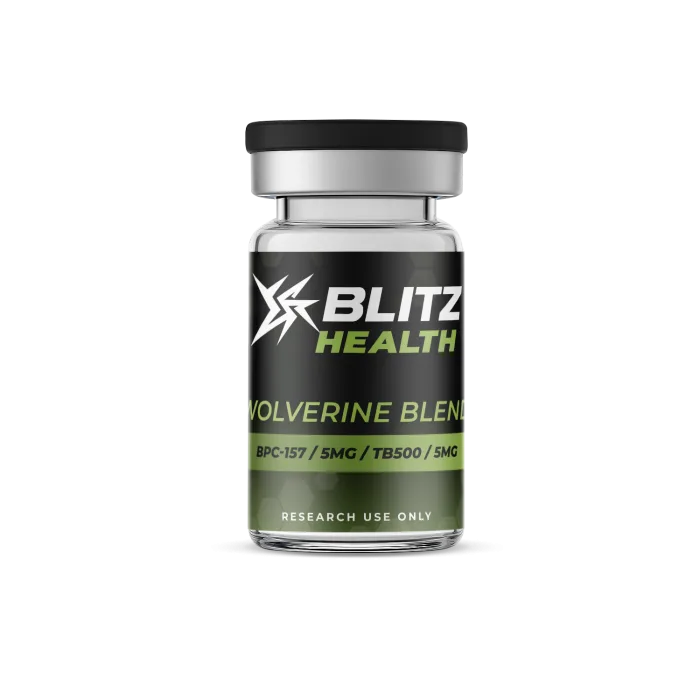
Wolverine Blend – BPC-157 (5mg) / TB500 (5mg) (Globally Sourced)
Price range: $78.00 through $128.00
- Third-party tested by certified labs
- Published certificates of analysis
- 98%+ purity standard
4 published certificates
Certificate information is temporarily unavailable.
Description
A two-component co-formulation supplied for controlled research environments. Suitable for studies involving GHRH-receptor pathway characterization and method development in model systems.
Composition
• BPC-157
• TB-500 (Thymosin Beta 4)
• Appearance: Lyophilized powder in a sealed research vial
Research Focus (non-clinical)
• Combined evaluation of BPC-157 and TB-500 in in-vitro or ex-vivo assay systems
• Assay development, including chromatographic separation of two co-formulated peptides
• Stability characterization of a two-analyte lyophilized blend under laboratory storage conditions
• Method documentation for HPLC/LC-MS identity and purity assessments
For qualified research professionals and institutional laboratories. Not for human use.
Documentation & Quality Assurance
Each lot is sourced through our verified global supply chain with emphasis on traceability and quality control. We work diligently to obtain and maintain third-party analytical reports (HPLC/LC-MS) and Certificates of Analysis for each batch, as part of our ongoing quality process. These documents are reviewed internally and displayed as they become available.
Important Notice
This product is intended for laboratory research use only. It is not intended for human or veterinary use, and must not be used for diagnostic, therapeutic, or clinical purposes.
This material is not a drug, medical device, or dietary supplement, and has not been evaluated by the U.S. Food and Drug Administration.
Quality & Manufacturing
We work directly with the manufacturers. Each supplier is reviewed for reliability, documentation integrity, and transparency in testing.
Our minimum purity standard is 98%. Every batch we ship has its own certificate of analysis, and every certificate confirms identity, purity and net content. Where available, endotoxin testing results are included on Certificates of Analysis to verify laboratory purity; their inclusion is for research quality assessment only and does not imply suitability for human or veterinary use.
All research materials are sealed for integrity and packaged for stability during storage and transport from manufacturing through final delivery.
About This Compound
What It Is
Wolverine Blend is a dual-component research peptide preparation combining BPC-157 — a synthetic pentadecapeptide (15 amino acid sequence: Gly-Glu-Pro-Pro-Pro-Gly-Lys-Pro-Ala-Asp-Asp-Ala-Gly-Leu-Val, MW 1419.55 Da) corresponding to a partial sequence of a protein from human gastric juice — with TB-500, a formulation identified as containing the N-terminal acetylated 17-23 fragment (Ac-LKKTETQ) of thymosin beta-4, a naturally occurring 43-amino-acid actin-sequestering peptide.
Research Background
BPC-157 has been examined predominantly in small-animal models (rats and mice) across intramuscular, intraperitoneal, and intragastric administration routes, with a small number of in vitro studies in endothelial cells and fibroblasts; as of the most recent systematic reviews, no completed human clinical trials have been published — one Phase I trial in 42 healthy volunteers (2015) was initiated but its results were never submitted or published. TB-500/thymosin beta-4 has been investigated in in vitro systems including human umbilical vein endothelial cells (HUVECs), human cardiac myocytes, cardiac fibroblasts, HepG2 cells, and intestinal epithelial cells, as well as in vivo in mouse models of myocardial infarction and chick chorioallantoic membrane angiogenesis models; TB-500 itself was characterized analytically by doping-control researchers using HPLC/high-resolution mass spectrometry to identify Ac-LKKTETQ in commercial formulations and biological matrices. Neither component has been approved for human therapeutic use by the FDA or other global regulatory authorities, and translational gaps between the animal and limited human data remain explicitly acknowledged in the peer-reviewed literature.
Observed Areas of Interest in Research
In preclinical models, BPC-157 research has focused on its interaction with the nitric oxide (NO) system — including modulation of nitric oxide synthase and upregulation of heme oxygenase (HO-1) — as well as activation of vascular endothelial growth factor receptor 2 (VEGFR2), upregulation of extracellular signal-regulated kinases (ERK1/2), reported growth hormone receptor expression in tendon fibroblasts, and region-specific modulation of dopamine and serotonin pathways in rodent models. Thymosin beta-4 research has centered on its primary function as an actin-sequestering peptide that regulates G-actin sequestration and actin filament dynamics; in cardiac cell culture and mouse infarction models, investigators have studied its modulation of ROCK1 protein levels (via miR139-5p upregulation and reduced ROCK1 mRNA), inhibition of fibroblast-to-myofibroblast transformation through Rho/ROCK signaling, and cell-type-specific MRTF-A/SRF pathway activity. Additional in vitro research has examined thymosin beta-4's nuclear-cytoplasmic trafficking behavior and its potential role in modulating inflammatory responses. All reported mechanisms derive from in vitro assays or animal model experiments; their relevance to human physiology has not been established in completed, peer-reviewed clinical trials.
Research Notes
Purity verified by third-party laboratory analysis (Certificate of Analysis available on request). Supplied strictly for in-vitro and laboratory research use only. Not for human consumption.
All information above is provided for research and educational reference only and summarizes findings from published scientific literature (predominantly in-vitro and animal models). It does not describe outcomes in humans. This product is not a drug, dietary supplement, or article intended for human or veterinary use.
Specifications
| Weight | 0.0625 lbs |
|---|---|
| Dosage | (5mg) / (5mg), (10mg) / (10mg) |
Certificate of Analysis
Certificate of Analysis
Every batch undergoes independent third-party laboratory analysis to verify identity, potency, and safety. Testing includes quantitative assay verification, heavy metals screening, and comprehensive microbial analysis.
All Available COAs
Storage Instructions
All products from Blitz Health are manufactured using a lyophilization (freeze-drying) process. This method is designed to maintain product integrity and allows vials to remain stable during shipping for approximately 3–4 months.
Once a vial is reconstituted with bacteriostatic water, it should be stored in the refrigerator to help maintain stability. Under these conditions, reconstituted material is generally considered stable for up to 30 days.
Lyophilization is a dehydration technique in which compounds are frozen and then exposed to low pressure. This causes the water in the vial to sublimate directly from solid to gas, leaving behind a stable, crystalline white structure. This powder can be kept at room temperature until reconstitution.
Upon receipt, products should be stored away from heat and light. For short-term use, refrigeration at approximately 4°C (39°F) is suitable. For long-term storage (several months to years), vials may be placed in a freezer at approximately -80°C (-112°F). Freezing is the preferred method for preserving product stability over extended periods.
⚠️ Important Notice:
These products are intended for research use only. Not for human consumption.
Frequently Paired in Research
Compounds frequently studied alongside Wolverine Blend – BPC-157 (5mg) / TB500 (5mg) (Globally Sourced) in the research literature — supplied strictly for in-vitro and laboratory research use only.