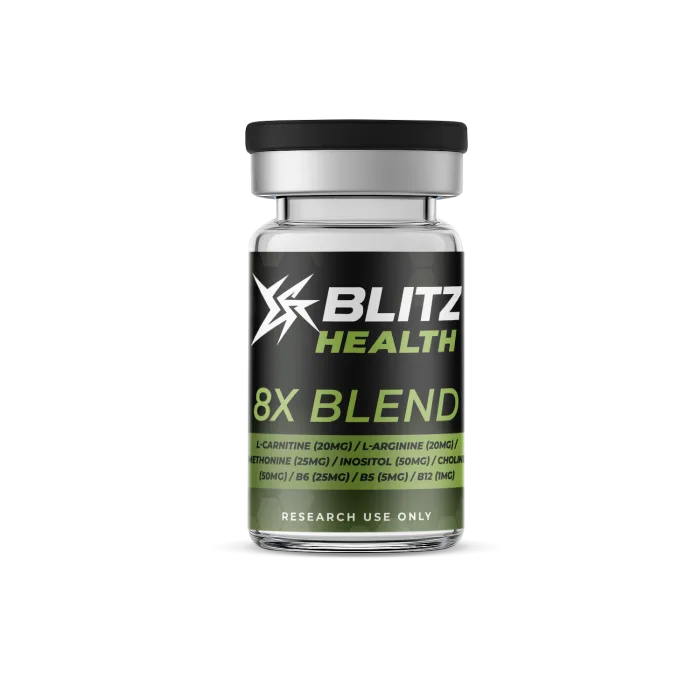
8X Blend L-Carnitine (20mg) / L-Arginine (20mg) / Methonine (25mg) / Inositol (50mg) / Choline (50mg) / B6 (25mg) / B5 (5mg) / B12 (1mg)
$38.00
- Third-party tested by certified labs
- Published certificates of analysis
- 98%+ purity standard
In stock
1 published certificate
Certificate information is temporarily unavailable.
Description
A multi-component research material supplied for controlled research environments. This 8X blend contains a synergistic combination of amino acids, vitamins, and cofactors designed for research into metabolic function, methylation pathways, and nutrient interaction studies in controlled laboratory settings.
Composition
• Pre-formulated liquid solution
• Total concentration: 196mg/mL — 10mL vial
• L-Carnitine 20mg/mL
• L-Arginine 20mg/mL
• L-Methionine 25mg/mL
• Inositol 50mg/mL
• Choline Chloride 50mg/mL
• Pyridoxine HCl (B6) 25mg/mL
• Calcium Pantothenate (B5) 5mg/mL
• Cyanocobalamin (B12) 1mg/mL
• Appearance: Fully constituted liquid solution in a sealed 10 mL research vial
• Storage: Keep out of light, tightly closed, dry. Store between 15–25°C (room temp) or 2–8°C (refrigerated). Do not freeze.
Research Focus (non-clinical)
• Investigation of amino acid and vitamin cofactor roles in metabolic pathways
• Studies on lipid metabolism and methylation cycle regulation
• Development of analytical assays for multi-component solution characterization
• Stability, sterility, and pH profiling under laboratory storage conditions
For qualified research professionals and institutional laboratories. Not for human use.
Documentation & Quality Assurance
Each lot is sourced through our verified global supply chain with emphasis on traceability and quality control. We work diligently to obtain and maintain third-party analytical reports (HPLC/LC-MS) and Certificates of Analysis for each batch, as part of our ongoing quality process. These documents are reviewed internally and displayed as they become available.
Important Notice
This product is intended for laboratory research use only. It is not intended for human or veterinary use, and must not be used for diagnostic, therapeutic, or clinical purposes.
This material is not a drug, medical device, or dietary supplement, and has not been evaluated by the U.S. Food and Drug Administration.
Quality & Manufacturing
We work directly with the manufacturers. Each supplier is reviewed for reliability, documentation integrity, and transparency in testing.
Our minimum purity standard is 98%. Every batch we ship has its own certificate of analysis, and every certificate confirms identity, purity and net content. Where available, endotoxin testing results are included on Certificates of Analysis to verify laboratory purity; their inclusion is for research quality assessment only and does not imply suitability for human or veterinary use.
All research materials are sealed for integrity and packaged for stability during storage and transport from manufacturing through final delivery.
About This Compound
What It Is
A multi-component research blend combining eight biochemically distinct molecules — L-carnitine (a quaternary ammonium compound synthesized endogenously from lysine and methionine), L-arginine (a semi-essential amino acid and nitric oxide synthase substrate), L-methionine (a sulfur-containing essential amino acid and SAM precursor), myo-inositol (a carbocyclic sugar integral to phosphoinositide signaling), choline (a nutrient serving as a precursor to phosphatidylcholine, acetylcholine, and betaine), pyridoxine (vitamin B6, whose active form pyridoxal-5-phosphate functions as a coenzyme in amino acid metabolism), pantothenic acid (vitamin B5, the obligate nutritional precursor to coenzyme A and acyl carrier protein), and cobalamin (vitamin B12, a cobalt-containing compound that acts as an essential cofactor in one-carbon metabolism).
Research Background
L-carnitine has been examined across Drosophila melanogaster models, rodent studies, and clinical metabolic research focused on its carnitine-shuttle function and conditions of carnitine deficiency. L-arginine has been studied in in vitro endothelial cell models, diabetic and hypertensive animal models (including LDL-receptor knockout mice), and human clinical trials using oral supplementation and flow-mediated dilation measurements to interrogate the arginine-to-nitric-oxide pathway. L-methionine and the homocysteine-methionine cycle have been investigated through bioinformatics mining of gene-expression datasets across many disease conditions, as well as in animal models employing methionine-choline deficient (MCD) diets in rodents that produced altered lipid-metabolism gene expression. Inositol has been examined primarily in in vitro systems, including CRISPR-mediated ISYNA1 knockout in HEK293T cells and Saccharomyces cerevisiae ino1Δ strains, to characterize its regulation of phospholipid pools and stress-signaling pathways. Choline has been studied in controlled human feeding trials, large epidemiologic cohorts (Framingham Heart Study, ARIC study), rodent choline-deficient diet models, and multiple genetic knockout mouse lines (Bhmt−/−, Chdh−/−, Pemt−/−). Vitamin B6 has been evaluated in animal experiments in rats, in vitro cancer and immune cell line studies, and observational clinical cohorts measuring plasma pyridoxal-5-phosphate levels. Pantothenic acid research has included small experimental deficiency studies and a prospective cohort study examining pantothenate intake and inflammatory markers. B12 and one-carbon metabolism have been characterized through in vitro cancer cell culture models, methionine-deficient animal studies, and human clinical research including folate-fortification outcome analyses and B12 supplementation trials measuring DNA methylation patterns.
Observed Areas of Interest in Research
Researchers have focused on the carnitine shuttle mechanism as a central pathway for L-carnitine: carnitine palmitoyltransferase 1 (CPT1) transfers the acyl moiety of long-chain acyl-CoA to L-carnitine; the carnitine-acylcarnitine translocase (CACT) transports the resulting acylcarnitine across the inner membrane; and CPT2 reconverts acylcarnitine to free L-carnitine and acyl-CoA in the matrix, enabling beta-oxidation — a pathway studied in cardiac, hepatic, and skeletal muscle models. For L-arginine, research has concentrated on the competitive relationship between nitric oxide synthase (NOS) and arginase: NOS oxidizes arginine to citrulline and nitric oxide in a reaction requiring NADPH, FAD, and FMN cofactors, whereas elevated arginase activity depletes the shared arginine substrate — a balance examined in endothelial dysfunction models. L-methionine research has centered on the homocysteine-methionine cycle: methionine is converted to S-adenosylmethionine (SAM) by methionine adenosyltransferase, SAM donates methyl groups to a broad array of methyltransferases, yielding S-adenosylhomocysteine (SAH), which is hydrolyzed to homocysteine; homocysteine is then either remethylated to methionine (a B12- and folate-dependent step via methionine synthase) or directed to transsulfuration, a pathway also studied in conjunction with B6 and B12 cofactor requirements. Inositol studies have examined its role as the obligate substrate for phosphatidylinositol (PI) synthase, with CRISPR depletion experiments reporting that inositol loss causes a more than three-fold decrease in PI levels and upregulation of the phosphatidylglycerol/cardiolipin branch. Choline research has examined three interrelated biochemical routes: (1) the CDP-choline (Kennedy) pathway producing phosphatidylcholine; (2) conversion to betaine, which serves as an alternative methyl donor feeding into remethylation of homocysteine to methionine; and (3) acetylcholine biosynthesis. Vitamin B6 (as pyridoxal-5-phosphate) has been studied as a coenzyme in many enzymatic reactions, with emphasis on transamination and decarboxylation of amino acids, its requirement by serine hydroxymethyltransferase (SHMT) in one-carbon transfer, and its role in cystathionine beta-synthase (CBS) in the transsulfuration pathway. Pantothenic acid (B5) research has characterized its obligate conversion to CoA and to acyl carrier protein (ACP), with acetyl-CoA identified as a central node connecting fatty acid synthesis, the tricarboxylic acid (TCA) cycle, and energy metabolism. Vitamin B12 has been studied as an essential cofactor for methionine synthase (using methylcobalamin) and for methylmalonyl-CoA mutase (using adenosylcobalamin), with human B12 supplementation research reporting measurable alterations in DNA methylation patterns.
Research Notes
Purity verified by third-party laboratory analysis (Certificate of Analysis available on request). Supplied strictly for in-vitro and laboratory research use only. Not for human consumption.
All information above is provided for research and educational reference only and summarizes findings from published scientific literature (predominantly in-vitro and animal models). It does not describe outcomes in humans. This product is not a drug, dietary supplement, or article intended for human or veterinary use.
Specifications
| Weight | 0.0625 lbs |
|---|
Certificate of Analysis
Certificate of Analysis
Every batch undergoes independent third-party laboratory analysis to verify identity, potency, and safety. Testing includes quantitative assay verification, heavy metals screening, and comprehensive microbial analysis.
View Certificate of AnalysisStorage Instructions
All products from Blitz Health are manufactured using a lyophilization (freeze-drying) process. This method is designed to maintain product integrity and allows vials to remain stable during shipping for approximately 3–4 months.
Once a vial is reconstituted with bacteriostatic water, it should be stored in the refrigerator to help maintain stability. Under these conditions, reconstituted material is generally considered stable for up to 30 days.
Lyophilization is a dehydration technique in which compounds are frozen and then exposed to low pressure. This causes the water in the vial to sublimate directly from solid to gas, leaving behind a stable, crystalline white structure. This powder can be kept at room temperature until reconstitution.
Upon receipt, products should be stored away from heat and light. For short-term use, refrigeration at approximately 4°C (39°F) is suitable. For long-term storage (several months to years), vials may be placed in a freezer at approximately -80°C (-112°F). Freezing is the preferred method for preserving product stability over extended periods.
⚠️ Important Notice:
These products are intended for research use only. Not for human consumption.
Frequently Paired in Research
Compounds frequently studied alongside 8X Blend L-Carnitine (20mg) / L-Arginine (20mg) / Methonine (25mg) / Inositol (50mg) / Choline (50mg) / B6 (25mg) / B5 (5mg) / B12 (1mg) in the research literature — supplied strictly for in-vitro and laboratory research use only.