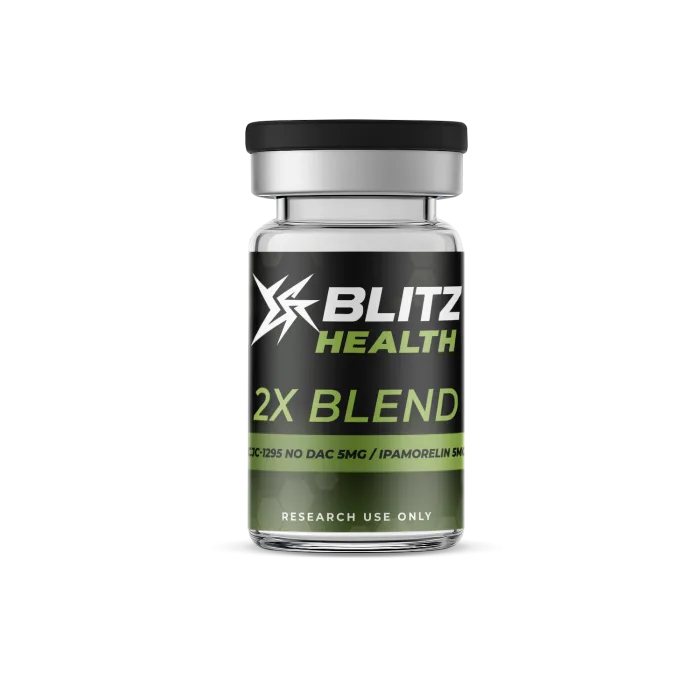
2X Blend CJC-1295 Without DAC (5mg) / Ipamorelin (5mg)
$58.00
- Third-party tested by certified labs
- Published certificates of analysis
- 98%+ purity standard
In stock
5 published certificates
Certificate information is temporarily unavailable.
Description
A 1:1 blend by mass of CJC-1295 (No DAC) and Ipamorelin supplied for controlled research environments. This co-formulation is suitable for studies exploring GHRH-receptor and ghrelin (GHS-R1a)–receptor signaling pathways when evaluated together in model systems.
Composition
• CJC-1295 (Without DAC)
• Ipamorelin
• Appearance: Lyophilized powder in a sealed research vial
Research Focus (non-clinical)
• Comparative and combined pathway evaluation of GHRH analog + GHS agonist in in-vitro or ex-vivo models
• Assessment of assay development, including chromatographic separation of co-formulated peptides
• Stability characterization of a two-analyte lyophilized blend under laboratory storage conditions
For qualified research professionals and institutional laboratories. Not for human use.
Documentation & Quality Assurance
Each lot is sourced through our verified global supply chain with emphasis on traceability and quality control. We work diligently to obtain and maintain third-party analytical reports (HPLC/LC-MS) and Certificates of Analysis for each batch, as part of our ongoing quality process. These documents are reviewed internally and displayed as they become available.
Important Notice
This product is intended for laboratory research use only. It is not intended for human or veterinary use, and must not be used for diagnostic, therapeutic, or clinical purposes.
This material is not a drug, medical device, or dietary supplement, and has not been evaluated by the U.S. Food and Drug Administration.
Quality & Manufacturing
We work directly with the manufacturers. Each supplier is reviewed for reliability, documentation integrity, and transparency in testing.
Our minimum purity standard is 98%. Every batch we ship has its own certificate of analysis, and every certificate confirms identity, purity and net content. Where available, endotoxin testing results are included on Certificates of Analysis to verify laboratory purity; their inclusion is for research quality assessment only and does not imply suitability for human or veterinary use.
All research materials are sealed for integrity and packaged for stability during storage and transport from manufacturing through final delivery.
About This Compound
What It Is
A research blend combining CJC-1295 without DAC (a synthetic analogue of growth hormone-releasing hormone, GHRH) and Ipamorelin (a pentapeptide of the sequence Aib-His-D-2-Nal-D-Phe-Lys-NH2 classified as a growth hormone-releasing peptide receptor agonist), representing two structurally distinct classes of molecules that each target the somatotropic axis through different receptor-level mechanisms.
Research Background
CJC-1295 without DAC (Mod-GRF(1-29)) is a synthetic GHRH analogue with enhanced plasma stability relative to endogenous GHRH. Preclinical research in GHRH-knockout mouse models has examined once-daily administration of a long-acting GHRH analogue and its relationship to body weight, body and bone length, lean and fat mass, pituitary GH mRNA expression, and somatotroph cell proliferation. A separate early-phase study in eleven healthy adult male volunteers used two-dimensional gel electrophoresis and mass spectrometry to characterize serum protein profile changes following a single CJC-1295 injection, identifying differential expression of several proteins including apolipoprotein A1 and transthyretin. Ipamorelin has been studied in primary rat pituitary cell cultures in vitro and in anesthetized rats and conscious swine in vivo, with researchers characterizing its potency and efficacy relative to reference peptides GHRP-6 and GHRP-2. Subsequent chronic-exposure research examined somatotroph cell populations in pituitary cultures from young female rats treated with ipamorelin for 21 days.
Observed Areas of Interest in Research
Researchers have studied CJC-1295 at the level of the hypothalamic-pituitary somatotropic axis, with investigations focusing on GHRH receptor engagement and downstream effects on pituitary somatotroph populations, GH mRNA expression, and systemic protein profiles. Ipamorelin has been characterized pharmacologically as acting through the GH-secretagogue (GHRP) receptor, and in vitro and in vivo studies in rat and swine models reported EC50 values and maximal efficacy measurements for GH release from primary pituitary cells; selectivity studies noted that, unlike GHRP-6 and GHRP-2, ipamorelin at doses more than 200-fold above its GH-releasing ED50 did not produce significant elevation of ACTH, cortisol, FSH, LH, PRL, or TSH in the models studied. The chronic rat pituitary cell culture work examined whether repeated ipamorelin exposure altered the composition and secretory responsiveness of somatotroph populations. Research on the two compounds reflects investigator interest in combining a GHRH-pathway agonist with a GH-secretagogue-pathway agonist as a means of studying convergent somatotropic signaling, though the peer-reviewed literature retrieved here examined each compound independently rather than in a formal co-administration study.
Research Notes
Purity verified by third-party laboratory analysis (Certificate of Analysis available on request). Supplied strictly for in-vitro and laboratory research use only. Not for human consumption.
All information above is provided for research and educational reference only and summarizes findings from published scientific literature (predominantly in-vitro and animal models). It does not describe outcomes in humans. This product is not a drug, dietary supplement, or article intended for human or veterinary use.
Specifications
| Weight | 0.0625 lbs |
|---|
Certificate of Analysis
Certificate of Analysis
Every batch undergoes independent third-party laboratory analysis to verify identity, potency, and safety. Testing includes quantitative assay verification, heavy metals screening, and comprehensive microbial analysis.
View Certificate of AnalysisStorage Instructions
All products from Blitz Health are manufactured using a lyophilization (freeze-drying) process. This method is designed to maintain product integrity and allows vials to remain stable during shipping for approximately 3–4 months.
Once a vial is reconstituted with bacteriostatic water, it should be stored in the refrigerator to help maintain stability. Under these conditions, reconstituted material is generally considered stable for up to 30 days.
Lyophilization is a dehydration technique in which compounds are frozen and then exposed to low pressure. This causes the water in the vial to sublimate directly from solid to gas, leaving behind a stable, crystalline white structure. This powder can be kept at room temperature until reconstitution.
Upon receipt, products should be stored away from heat and light. For short-term use, refrigeration at approximately 4°C (39°F) is suitable. For long-term storage (several months to years), vials may be placed in a freezer at approximately -80°C (-112°F). Freezing is the preferred method for preserving product stability over extended periods.
⚠️ Important Notice:
These products are intended for research use only. Not for human consumption.
Frequently Paired in Research
Compounds frequently studied alongside 2X Blend CJC-1295 Without DAC (5mg) / Ipamorelin (5mg) in the research literature — supplied strictly for in-vitro and laboratory research use only.