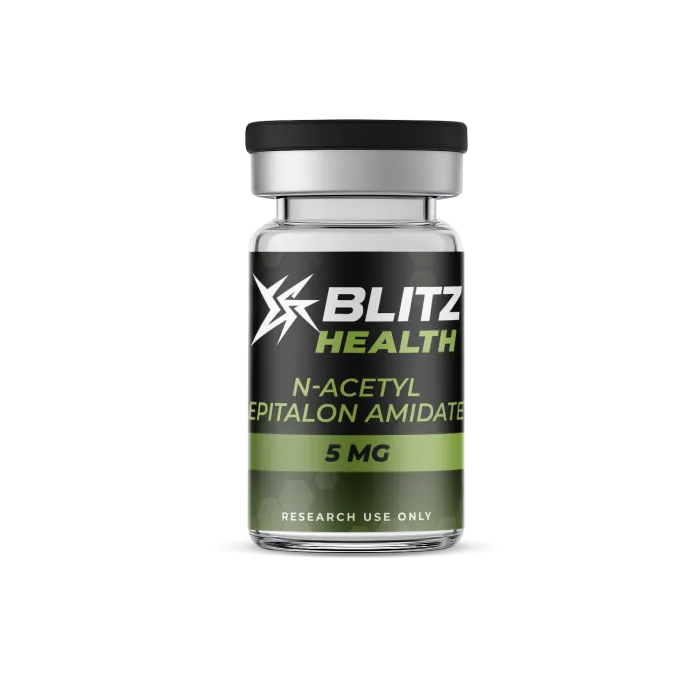
N-Acetyl Epitalon Amidate (5 mg)
$38.00
- Third-party tested by certified labs
- Published certificates of analysis
- 98%+ purity standard
In stock
1 published certificate
Certificate information is temporarily unavailable.
Description
A single-component research material supplied for controlled research environments. N-Acetyl Epitalon Amidate (5 mg) is a synthetic tetrapeptide analog designed for research exploring telomeric activity, aging-related signaling pathways, and pineal peptide biochemistry in model systems.
Composition
• N-Acetyl Epitalon Amidate
• Appearance: Lyophilized powder in a sealed research vial
Research Focus (non-clinical)
• Peptide identity and purity assessment via HPLC/LC-MS
• Assay development and calibration for quantitative analysis
• Chromatographic method optimization for impurity profiling and peak resolution
• Stability characterization of a lyophilized peptide under laboratory storage conditions
For qualified research professionals and institutional laboratories. Not for human use.
Documentation & Quality Assurance
Each lot is sourced through our verified global supply chain with emphasis on traceability and quality control. We work diligently to obtain and maintain third-party analytical reports (HPLC/LC-MS) and Certificates of Analysis for each batch, as part of our ongoing quality process. These documents are reviewed internally and displayed as they become available.
Important Notice
This product is intended for laboratory research use only. It is not intended for human or veterinary use, and must not be used for diagnostic, therapeutic, or clinical purposes.
This material is not a drug, medical device, or dietary supplement, and has not been evaluated by the U.S. Food and Drug Administration.
Quality & Manufacturing
We work directly with the manufacturers. Each supplier is reviewed for reliability, documentation integrity, and transparency in testing.
Our minimum purity standard is 98%. Every batch we ship has its own certificate of analysis, and every certificate confirms identity, purity and net content. Where available, endotoxin testing results are included on Certificates of Analysis to verify laboratory purity; their inclusion is for research quality assessment only and does not imply suitability for human or veterinary use.
All research materials are sealed for integrity and packaged for stability during storage and transport from manufacturing through final delivery.
About This Compound
What It Is
N-Acetyl Epitalon Amidate is a synthetically modified tetrapeptide derived from the base sequence Ala-Glu-Asp-Gly (Epitalon/AEDG) — itself originally synthesized from the amino acid composition of Epithalamin, a bovine pineal gland extract — in which an N-terminal acetyl group and a C-terminal amide group have been added to the parent sequence.
Research Background
No published peer-reviewed literature was identified that specifically examines the N-acetyl/C-amidated modified form of Epitalon. The extensive research base exists for the parent tetrapeptide Epitalon (AEDG). Studies on Epitalon span multiple model systems, including in vitro work with human cell lines (HeLa, THP-1 monocytes, SH-SY5Y neuroblastoma, human gingival mesenchymal stem cells, and several cancer cell lines), animal models ranging from Drosophila melanogaster through rodents (Wistar and Sprague Dawley rats; CBA and HER-2/neu transgenic mice) to Rhesus monkeys, and limited early clinical investigations in cohorts such as 162 patients with retinitis pigmentosa and a cohort of 75 women examined for circadian rhythm parameters, as documented in a 2025 PMC review. A 2025 in vitro study examined Epitalon in human cancer and normal cell lines using qPCR, TRAP assay, C-circle assay, and immunofluorescence, with the authors noting that cell culture in 2D models represents an acknowledged methodological limitation.
Observed Areas of Interest in Research
Researchers studying the parent Epitalon tetrapeptide have investigated several molecular areas. In the area of telomere biology, investigators measured hTERT mRNA expression and telomerase enzyme activity in normal human cell lines and examined alternative lengthening of telomeres (ALT) activity via C-circle assay and PML body detection in cancer-derived lines. Epigenetic and chromatin-level interactions have also been studied: computational modeling showed that the AEDG peptide forms hydrogen bonds with histone H1/6 (binding energy −64.51 kcal/mol) and histone H1/3 at sites that interact with DNA, leading researchers to propose a competitive epigenetic mechanism. Additional pathways examined in the literature include neuroendocrine signaling — specifically AANAT and pCREB regulation linked to melatonin synthesis in pineal cells — as well as antioxidant enzyme modulation (superoxide dismutase, catalase), interleukin-2 mRNA expression, and acetylcholinesterase/butyrylcholinesterase activity, all as catalogued in the 2025 comprehensive review. The N-terminal acetyl and C-terminal amide modifications present in N-Acetyl Epitalon Amidate are well-established in peptide chemistry as structural changes that can alter proteolytic stability and physicochemical properties; however, whether these modifications alter the receptor-binding or pathway interactions documented for Epitalon has not been reported in the indexed peer-reviewed literature identified during this search.
Research Notes
Purity verified by third-party laboratory analysis (Certificate of Analysis available on request). Supplied strictly for in-vitro and laboratory research use only. Not for human consumption.
All information above is provided for research and educational reference only and summarizes findings from published scientific literature (predominantly in-vitro and animal models). It does not describe outcomes in humans. This product is not a drug, dietary supplement, or article intended for human or veterinary use.
Specifications
| Weight | 0.0625 lbs |
|---|
Certificate of Analysis
Certificate of Analysis
Every batch undergoes independent third-party laboratory analysis to verify identity, potency, and safety. Testing includes quantitative assay verification, heavy metals screening, and comprehensive microbial analysis.
View Certificate of AnalysisStorage Instructions
All products from Blitz Health are manufactured using a lyophilization (freeze-drying) process. This method is designed to maintain product integrity and allows vials to remain stable during shipping for approximately 3–4 months.
Once a vial is reconstituted with bacteriostatic water, it should be stored in the refrigerator to help maintain stability. Under these conditions, reconstituted material is generally considered stable for up to 30 days.
Lyophilization is a dehydration technique in which compounds are frozen and then exposed to low pressure. This causes the water in the vial to sublimate directly from solid to gas, leaving behind a stable, crystalline white structure. This powder can be kept at room temperature until reconstitution.
Upon receipt, products should be stored away from heat and light. For short-term use, refrigeration at approximately 4°C (39°F) is suitable. For long-term storage (several months to years), vials may be placed in a freezer at approximately -80°C (-112°F). Freezing is the preferred method for preserving product stability over extended periods.
⚠️ Important Notice:
These products are intended for research use only. Not for human consumption.
Frequently Paired in Research
Compounds frequently studied alongside N-Acetyl Epitalon Amidate (5 mg) in the research literature — supplied strictly for in-vitro and laboratory research use only.