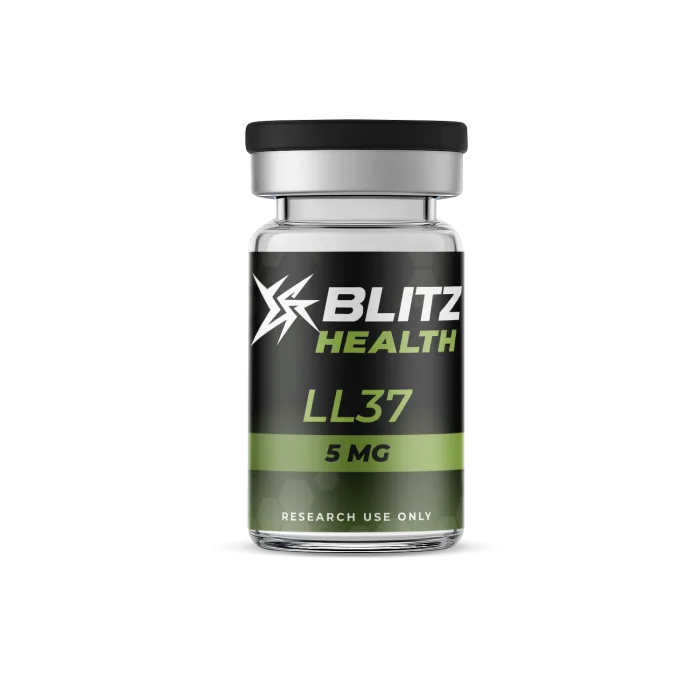
LL37 (5mg)
$48.00
- Third-party tested by certified labs
- Published certificates of analysis
- 98%+ purity standard
In stock
1 published certificate
Certificate information is temporarily unavailable.
Description
A single-component research material supplied for controlled research environments. LL-37 is a synthetic cathelicidin-derived peptide used in research exploring innate immunity, antimicrobial pathways, and wound-healing models in controlled systems.
Composition
• LL-37
• Appearance: Lyophilized powder in a sealed research vial
Research Focus (non-clinical)
• Characterization of LL-37 in antimicrobial activity assays
• Studies on immune modulation and inflammatory pathway signaling
• Evaluation in cell culture and tissue models related to epithelial repair
• Stability and solubility profiling under laboratory storage conditions
For qualified research professionals and institutional laboratories. Not for human use.
Documentation & Quality Assurance
Each lot is sourced through our verified global supply chain with emphasis on traceability and quality control. We work diligently to obtain and maintain third-party analytical reports (HPLC/LC-MS) and Certificates of Analysis for each batch, as part of our ongoing quality process. These documents are reviewed internally and displayed as they become available.
Important Notice
This product is intended for laboratory research use only. It is not intended for human or veterinary use, and must not be used for diagnostic, therapeutic, or clinical purposes.
This material is not a drug, medical device, or dietary supplement, and has not been evaluated by the U.S. Food and Drug Administration.
Quality & Manufacturing
We work directly with the manufacturers. Each supplier is reviewed for reliability, documentation integrity, and transparency in testing.
Our minimum purity standard is 98%. Every batch we ship has its own certificate of analysis, and every certificate confirms identity, purity and net content. Where available, endotoxin testing results are included on Certificates of Analysis to verify laboratory purity; their inclusion is for research quality assessment only and does not imply suitability for human or veterinary use.
All research materials are sealed for integrity and packaged for stability during storage and transport from manufacturing through final delivery.
About This Compound
What It Is
LL-37 is a 37-amino acid cationic, amphipathic peptide of the cathelicidin family, constituting the C-terminal antimicrobial domain proteolytically cleaved from the precursor protein hCAP18 (human cationic antimicrobial protein 18 kDa), and is the sole cathelicidin identified in humans to date.
Research Background
LL-37 has been examined across a range of experimental systems, including in vitro cell-line models (cancer cell lines derived from ovarian, colon, lung, breast, and hematologic tissues, as well as primary human epidermal keratinocytes), animal models including nude-mouse xenograft and syngeneic colon cancer models, and observational clinical studies measuring peptide expression levels in patient-derived tissues and blood. A 2025 review in the PubMed-indexed literature surveyed chemical and structural modification strategies for the peptide and its analogs, characterizing the breadth of research into its antimicrobial, antiviral, antifungal, antiparasitic, and immunomodulatory properties across these systems. Research interest has also extended to the precursor hCAP18 prosequence, with studies characterizing the role of proteinase 3-mediated cleavage in releasing the active LL-37 fragment from its conserved cathelin-like domain.
Observed Areas of Interest in Research
Investigators have documented LL-37's interaction with multiple cell-surface and intracellular receptors in experimental models, including formyl peptide receptor 2 (FPR2/FPRL-1), epidermal growth factor receptor (EGFR), purinergic receptor P2X7, insulin-like growth factor-1 receptor (IGF-1R), Toll-like receptor 4 (TLR-4), and scavenger receptors SR-B1 (SCARB1), SR-E1 (OLR1), and SR-J1 (AGER/RAGE). Downstream signaling studied in these contexts includes IGF-1R-associated, beta-arrestin-1-dependent MAPK/ERK activation, NF-kB activation, and — when the peptide facilitates cellular uptake of nucleic acids — TLR3/RIG-I/MDA5/MAVS-dependent type I interferon induction via TBK1 and IRF3 phosphorylation. In immunological research models, LL-37 has been studied for its capacity to modulate cytokine and chemokine production, including IL-1beta, IL-6, IL-8, TNF-alpha, IFN-beta, and CXCL10. Researchers have additionally studied caspase-independent apoptotic pathway engagement in cancer cell models, involving AIF, EndoG, and Bax/Bak proteins.
Research Notes
Purity verified by third-party laboratory analysis (Certificate of Analysis available on request). Supplied strictly for in-vitro and laboratory research use only. Not for human consumption.
All information above is provided for research and educational reference only and summarizes findings from published scientific literature (predominantly in-vitro and animal models). It does not describe outcomes in humans. This product is not a drug, dietary supplement, or article intended for human or veterinary use.
Specifications
| Weight | 0.0625 lbs |
|---|
Certificate of Analysis
Certificate of Analysis
Every batch undergoes independent third-party laboratory analysis to verify identity, potency, and safety. Testing includes quantitative assay verification, heavy metals screening, and comprehensive microbial analysis.
View Certificate of AnalysisStorage Instructions
All products from Blitz Health are manufactured using a lyophilization (freeze-drying) process. This method is designed to maintain product integrity and allows vials to remain stable during shipping for approximately 3–4 months.
Once a vial is reconstituted with bacteriostatic water, it should be stored in the refrigerator to help maintain stability. Under these conditions, reconstituted material is generally considered stable for up to 30 days.
Lyophilization is a dehydration technique in which compounds are frozen and then exposed to low pressure. This causes the water in the vial to sublimate directly from solid to gas, leaving behind a stable, crystalline white structure. This powder can be kept at room temperature until reconstitution.
Upon receipt, products should be stored away from heat and light. For short-term use, refrigeration at approximately 4°C (39°F) is suitable. For long-term storage (several months to years), vials may be placed in a freezer at approximately -80°C (-112°F). Freezing is the preferred method for preserving product stability over extended periods.
⚠️ Important Notice:
These products are intended for research use only. Not for human consumption.
Frequently Paired in Research
Compounds frequently studied alongside LL37 (5mg) in the research literature — supplied strictly for in-vitro and laboratory research use only.